



Vatican Library & Secret Archives: Access for the Privileged Few
Behind the colonnade of St Peter’s Square, on the second floor of a Renaissance courtyard most visitors never enter, lies what may be the most extraordinary single room in Christendom — the Salone Sistino of the Vatican Apostolic Library. Sixty-seven metres long, frescoed by Sixtus V’s court painters in 1588, lined with cabinets that still contain incunables from the very earliest years of printing — and almost entirely closed to the public. Access to the Vatican Library, and its even more elusive sister institution the Apostolic Archive, is one of the rarest privileges in private cultural travel.
This guide is for travellers who understand that “exclusive” is not a marketing word but a logistical reality: such a visit requires months of correspondence, an institutional letter of presentation, and a guide who knows the prefects personally. It is also one of the most unforgettable mornings you will ever spend in Rome.
The distinction: Library vs Archive
It is essential to understand that the Vatican Library (Biblioteca Apostolica Vaticana) and the Vatican Apostolic Archive (formerly Secret Archive, Archivio Apostolico Vaticano) are two separate institutions, each with their own reading rooms, prefects, and access protocols. The Library, founded by Nicholas V in 1451, holds approximately 1.6 million printed books, 8,500 incunables, and 80,000 manuscripts — including the Codex Vaticanus, one of the oldest surviving complete Bibles. The Archive, by contrast, holds the working papers of the papacy: eighty-five linear kilometres of documents stretching from the eighth century to the present, including the trial of the Templars, Henry VIII’s request for annulment, the correspondence of Galileo, and the recently opened files of Pius XII.
For most private visitors, the Library is the achievable goal. The Archive is granted only to credentialed researchers — and even then only after written application to the Prefect.
What a private morning in the Library actually looks like
A privately arranged visit begins at the Cortile del Belvedere — not at the public museum entrance, but at the Library’s own side door, where a uniformed Swiss Guard checks your name against the day’s list. You are received by a Library staff member or, on more privileged programmes, by one of the curators of the manuscript department. The visit moves first through the Salone Sistino — the great frescoed hall — where you can read, at a respectful distance, the names of every Apostolic Father painted into the lunettes by Cesare Nebbia and Giovanni Guerra.
From there, depending on the seniority of access arranged, you proceed to one of the consultation rooms. On exceptional visits, a curator brings out a small selection of manuscripts laid on velvet cushions: perhaps a page from a tenth-century Carolingian sacramentary, an illuminated Book of Hours from the Burgundian court, the Codex Urbinas (Leonardo da Vinci’s treatise on painting), or a single early printed leaf from Gutenberg’s workshop. You do not touch. You lean close. You listen as the curator explains, in Italian or English, the place of the object in the history of European thought.
What such a visit is — and is not
It is essential, in setting expectations, to be honest. This is not a “tour” in the conventional sense. There is no audioguide, no photography, no gift shop. The visit may last only ninety minutes. The objects shown depend entirely on what the curator on duty considers appropriate that morning. Some days the Library is closed entirely — for major papal audiences, for the conclave preparations, for technical maintenance. Even with months of planning, the answer can be “not this week.”
It is also not a religious experience in the conventional sense, although for many visitors it becomes one. The Vatican Library is, above all, a working scholarly institution. The serious researchers who pass you in the corridor are studying patristics, Renaissance music, Slavic liturgy. To visit is to be permitted, briefly, into the workshop of European memory.
Who can realistically arrange this
Private Library access is granted, in practice, to three categories of visitor: credentialed academics with a research subject; representatives of cultural institutions (museum directors, library directors, foundation trustees); and discerning private travellers introduced by a recognised guide with standing letters of presentation. Olga has, over the past decade, built relationships with the Library’s reception office and with several curators. This makes occasional private visits possible for cultivated travellers — but the lead time is real. Three months is the minimum; six months is more typical; and a letter outlining your reasons for visiting is always required.
Pairing the Library with the rest of the Vatican
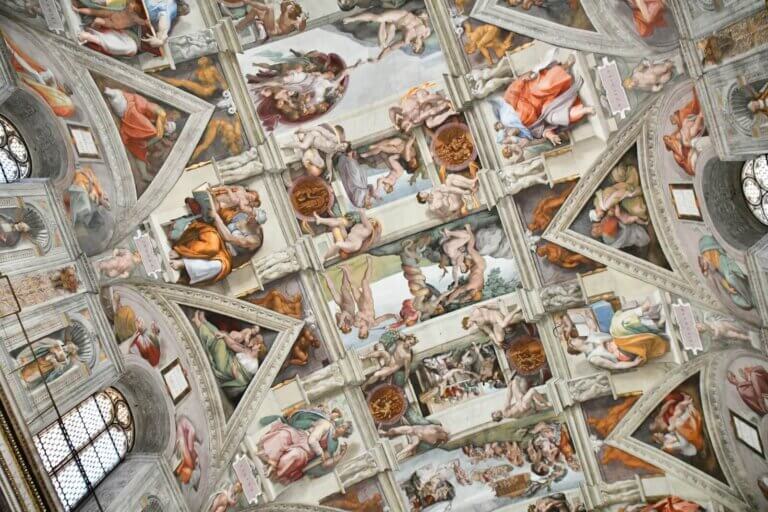
A Library morning pairs beautifully with a full-day Vatican programme. The natural complement is the exclusive Vatican tour in the afternoon — Pinacoteca, Borgia Apartments, Sistine — followed, if the timing permits, by a private dinner in Borgo. For travellers also drawn to the Sistine Chapel after-hours, see our companion piece on the Sistine Chapel night opening. For families with adolescent children of serious curiosity, we sometimes combine a brief Library reception with a private mosaic and fresco masterclass with a Vatican-trained restorer in the afternoon — a way for children to touch, with their own hands, the techniques whose ancient examples they have just seen.
A final note on dress and conduct
The Library and the Archive are houses of work. Dress is formal: jacket for men, equivalent for women, no shorts under any circumstances, closed shoes. Mobile phones are silenced and left in pockets. Voices are kept low. You do not lean over the desks of working scholars. You do not photograph manuscripts, even when invited to look closely. In return for these small disciplines, the Library offers something almost no other institution in the world can: an unmediated, hour-long encounter with the writing surface of European civilisation.
Such access is curated personally and one programme at a time. To explore feasibility for your travel dates, write to Olga via Telegram.
Further Reading & Official Sources
Independent verification and official references:
From the Journal to your private day
Live this privately
 Exclusive Vatican: A World of Grandeur, Art, and Spirituality
 Vatican Without Queues: Discover the Treasures of the Holy See
Every day is composed around you — your pace, your interests, your time. Tell Olga what you would like to see.
Speak with Olga All private tours in Rome Build your day