



Amalfi Town: The Cathedral Cloister and the Paper Museum
In the eleventh century Amalfi was one of the four Maritime Republics, with a quarter in Constantinople, a fleet that traded as far as Alexandria, and a maritime law (the Tabula Amalphitana) that governed the Mediterranean for four hundred years. The earthquake of 1343 sank half the lower town beneath the sea. What remains is a small, vertical, salt-stained town with one of the strangest cathedral cloisters in southern Italy, a paper-making tradition that pre-dates anything north of the Alps, and a back valley where five medieval water-mills still grind rags into pulp.
The Duomo di Sant’Andrea and the Cloister of Paradise
The cathedral of Saint Andrew dominates the piazza by an extravagant flight of sixty-two steps. The façade is a nineteenth-century reconstruction in Arab-Norman style — black-and-white striped marble, mosaics in the gable, a small bronze door cast in Constantinople in 1066 — but the cloister behind it is the original article. The Chiostro del Paradiso, built between 1266 and 1268 as a burial ground for the noble families of Amalfi, has paired columns supporting Moorish-style interlaced arches in pure white plaster: an architecture you would expect in Andalusia, not on a Tyrrhenian coast. Fragments of Roman sarcophagi line the four walls. The crypt below holds, by tradition, the relics of Saint Andrew, brought from Constantinople in 1208 by Cardinal Pietro Capuano.
The Paper Museum and the carta a mano of the Valle dei Mulini
A short walk inland from the piazza follows the Canneto torrent into the Valle dei Mulini — the Valley of the Mills — where Amalfi made paper for the Vatican, the Bourbon court and the Naples banking houses from the twelfth century onward. The technique came east from China via the Arab world; the rag-and-water method (called carta a mano) produced sheets of exceptional weight and texture, sold in the eighteenth century at thirty times the price of standard European paper. The Museo della Carta, housed in a thirteenth-century mill, still operates one working wheel and one beating-trough; a private demonstration, arranged outside the museum’s normal hours, lets you make a sheet of carta a mano yourself, watermark and all, and take it home dried.
Lunch at Marina Grande, then a private boat to the Emerald Grotto
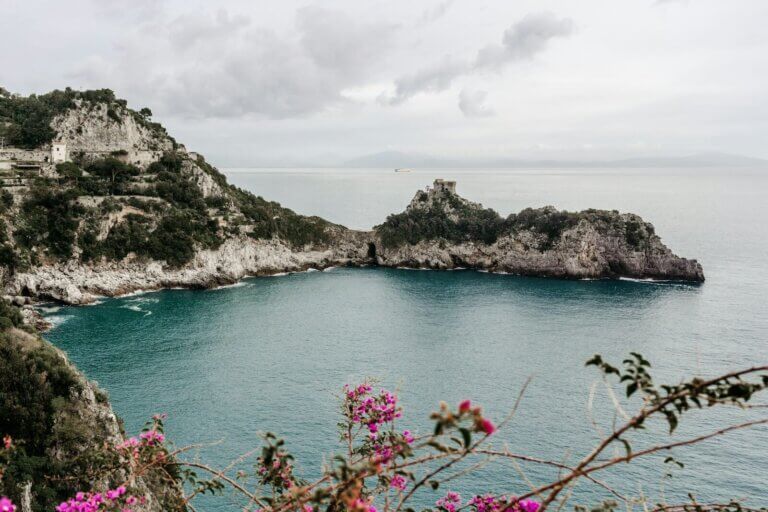
The most agreeable lunch in Amalfi is at Marina Grande, on the beach, where the Proto family have run a quiet table since 1947 — grilled prawns from the bay, scialatielli ai frutti di mare, a delicate fritto misto. After lunch, a private boat takes the short hop along the coast to the Grotta dello Smeraldo at Conca dei Marini, a sea-cave that turns brilliant green under the late-afternoon sun. The water is filtered through a submerged opening that polarises the light; the effect, unlike the Blue Grotto, is calm and slow.
How the morning fits the larger day
Amalfi pairs with either Ravello (twenty minutes uphill) or Positano (forty minutes north) for a complete day from Rome. The classical sequence is Positano boutiques in the morning, lunch at Le Sirenuse, Amalfi cathedral and paper-museum in the afternoon, the Emerald Grotto at 17:00, and a return to Rome by 23:00. For garden-lovers, swap Positano for Ravello. See also our Amalfi Coast premium one-day itinerary, the classic full-day from Rome, and the private helicopter alternative when the road feels like too much.
Ready to plan your private day? Olga curates each itinerary personally — speed-boat captains, family-run kitchens, garden visits before opening, drivers who treat the autostrada like a Maserati commercial. Contact Olga via Telegram to begin.
From the Journal to your private day
Live this privately
Every day is composed around you — your pace, your interests, your time. Tell Olga what you would like to see.
Speak with Olga All private tours in Rome Build your day