



Salerno: The Forgotten Royal Court
For two centuries Salerno was the most important city in southern Italy. Between 970 and 1140 it was the capital of the Lombard principality, the seat of the Schola Medica Salernitana — Europe’s first medical school — and the burial place of one of the four evangelists. The Normans took it in 1077, the Hohenstaufen in 1194, and slowly the city was overshadowed by Naples. Twentieth-century travel guides barely mention it. For a private day from Rome at the southern end of the Amalfi Coast, Salerno is the great, calm, slightly melancholic surprise — a working Mediterranean city with a Norman cathedral, a Lombard castle, and a sea-front promenade that the locals walk every evening.
The Cathedral of Saint Matthew
The Duomo of Salerno, consecrated in 1084 by Pope Gregory VII (who is buried in the right transept), holds the relics of Saint Matthew the Evangelist, brought from Paestum in 954. The portico of twenty-eight pillaged Roman columns, the bronze doors cast in Constantinople in 1099, the two great medieval ambones in coloured marble inlay, and the crypt with its underground chapel and double altar back-to-back — all are essentially untouched and almost entirely unvisited. The crypt frescoes, restored in the 2010s, glow softly under low light; the small cloister behind the cathedral hosts a single fig tree planted by Pope Gregory’s chaplain.
The Lombard Arechi Castle
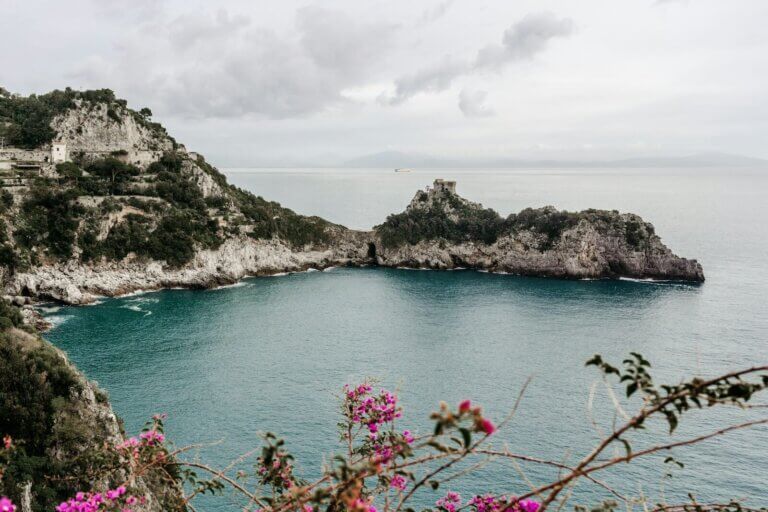
Above the city, three hundred metres up the Bonadies hill, sits the Castello di Arechi — a Lombard castle begun in the sixth century, expanded by Duke Arechis II in the eighth, and used by every successive ruler of Salerno until the seventeenth. The castle is reached by a five-minute drive up a switchback road, or — if your guest is feeling sporty — by a forty-minute walk through Mediterranean scrub. The view from the upper terrace covers the whole arc of the Gulf of Salerno from Punta Licosa to Vietri, including a profile of the Amalfi Coast that no photograph captures. The small museum inside the castle holds ceramics, weapons and a thirteenth-century manuscript page from the medical school.
The Schola Medica Salernitana
Founded by tradition in the ninth century — by a Greek, a Jew, an Arab and a Latin pooling their medical knowledge — the Schola Medica was Europe’s first university faculty of medicine. It taught women (Trotula of Salerno, the first female academic of European medicine, wrote her treatise De Mulierum Passionibus here around 1100). The Giardino della Minerva, on the slope above the cathedral, is the school’s surviving herb garden, replanted with the medicinal species used in the medieval pharmacopoeia. A private morning visit includes a guided tasting of three monastic herbal infusions on the terrace overlooking the gulf.
A long lunch on the Lungomare
Salerno’s sea-front, the Lungomare Trieste, runs almost two kilometres under a double row of palms; the locals call it the most beautiful promenade in Italy after Naples’s Lungomare Caracciolo, and they may be right. The pleasant lunch is at Pescheria, where the catch is selected from a glass counter and grilled simply with lemon and olive oil. After lunch, a coffee at one of the historic cafés on Via dei Mercanti closes a quiet day.
Pairings from Rome
Salerno is two and a half hours from Rome by car, or three and a half if combined with an Amalfi stop. The natural pairing is a half-day in Salerno followed by an evening in Vietri sul Mare (the southernmost town of the Amalfi Coast, famous for its ceramics) and a return to Rome the following morning — or a long single day with a Paestum lunch on the way home. See our premium one-day Amalfi itinerary, and for further south, the day at Ostia Antica vs Pompeii.
Ready to plan your private day? Olga curates each itinerary personally — speed-boat captains, family-run kitchens, garden visits before opening, drivers who treat the autostrada like a Maserati commercial. Contact Olga via Telegram to begin.
From the Journal to your private day
Live this privately
Every day is composed around you — your pace, your interests, your time. Tell Olga what you would like to see.
Speak with Olga All private tours in Rome Build your day