



Vicus Caprarius: The City Beneath Trevi
Nine metres below the Trevi Fountain, behind a small bronze door on the Vicolo del Puttarello, lies an entire fragment of Imperial Rome that almost no one above ground knows: the Vicus Caprarius, the «City of Water» — a four-storey Roman insula, an open cistern of the Acqua Vergine aqueduct, and a private museum that displays everything excavated on site, including a marble portrait of the Emperor Alexander Severus and a hoard of late-imperial coins. The site opened to the public only in 2003, holds no more than thirty visitors at a time, and is reached down a polished steel staircase that begins exactly under the feet of the tourists photographing the fountain. It is, almost certainly, the most luxurious underground site in Rome.
What the excavation reveals
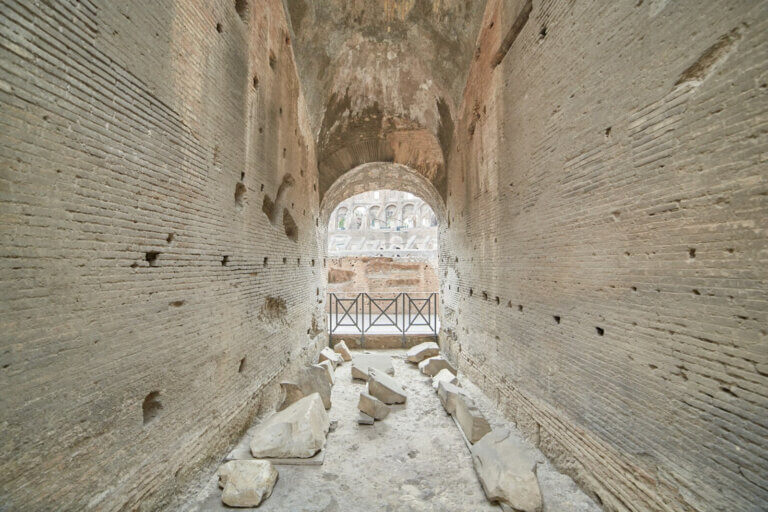
The site was discovered in 1999 during the restoration of the Cinema Trevi above it. Archaeologists expected late-medieval foundations and instead found a complete first-century apartment building — original travertine pillars, mosaic floors, a still-running cistern fed by the Acqua Vergine, the Roman aqueduct that, two thousand years later, still feeds the Trevi Fountain itself. The transformation of the insula from a residential block in the first century to a luxury domus in the third — with marble revetments, an oculus, and an under-floor heating system — corresponds exactly to the period when the surrounding quarter, the Vicus Caprarius, was reorganised by Hadrian.
The cistern, and the engineering it preserves
The cistern itself is the spectacle. A vaulted brick chamber, roughly twelve metres long, holds a layer of running water — clear, cold, and audible — that drains via an original Roman channel directly to the supply system of the Trevi. The Acqua Vergine has been continuously running since 19 BCE; it was commissioned by Agrippa for the Baths of Agrippa in Campo Marzio, restored by Pope Nicholas V in 1453, and rebuilt by Pope Pius V in 1570. Standing on the steel walkway above the cistern, with the sound of the running aqueduct under one’s feet, is the most direct sensory contact with imperial Rome’s water engineering that the city offers.
The objects on display
The museum is small — a single rectangular room with cases on three sides — but its contents are luxurious. The marble portrait of Alexander Severus (222–235 CE), unearthed on the site, is among the finest third-century imperial portraits to have entered a Roman museum since the 1970s. A hoard of late-imperial coins — more than 850 silver and bronze pieces — was found in a sealed amphora. A set of glass beakers and oil lamps, an iron statue base, and several sets of mosaic floor fragments fill out the display. The cumulative effect is that of a small luxury private archaeological apartment, curated with the tact of a gallery rather than the density of a state museum.
How a private visit arranges itself
The Vicus Caprarius is best entered between 10:00 and 11:30, when the Trevi crowd is at its densest above and the underground site, by contrast, is whispering empty. Olga arranges a reserved entrance, walks her guests through the cistern and museum in a slow forty-five minutes, and then resurfaces with them at the fountain itself — where the ground above is, suddenly, transparent in their reading of it. The most natural continuation is the Galleria Sciarra ninety seconds away, followed by a coffee at Sant’Eustachio and a slow lunch at the Pantheon. Our full underground Rome itinerary includes the Vicus Caprarius among four other subterranean sites.
Combining with the Vatican and Sistine Chapel
The Vicus Caprarius is small enough that it pairs naturally with a major morning. The most demanded combination among our private guests is the underground site at 10:00, the Sistine Chapel night opening the same evening, and a private dinner between — a contrast of Roman water engineering and Vatican painting that is, in our small jurisdiction, perfectly compressed.
A final note on conservation
The site has been managed since 2003 by a private cooperative under the supervision of the Soprintendenza, and the curatorial quality of the cases is unusually high for a small underground museum. The site limits itself to thirty visitors at a time and does not appear on group-tour itineraries. The result is the most discreet underground site in Rome, four hundred metres from the Pantheon and one hundred from one of the city’s most photographed sights — and known, in practice, to fewer than five percent of Rome’s annual visitors.
To arrange a private morning at the Vicus Caprarius beneath the Trevi Fountain, contact Olga via Telegram.
From the Journal to your private day
Live this privately
Every day is composed around you — your pace, your interests, your time. Tell Olga what you would like to see.
Speak with Olga All private tours in Rome Build your day