


Frascati Beyond Wine: Villa Aldobrandini’s Architectural Secrets
Frascati is, for most travellers, a wine town — and the wine, the Frascati Superiore, is sufficient justification for a day. But behind the vineyards, on the slope above the village, rises one of the most extraordinary patrician villas of late-Renaissance Italy: the Villa Aldobrandini, built between 1598 and 1602 by Cardinal Pietro Aldobrandini (nephew of Pope Clement VIII) to a design by Giacomo della Porta — Michelangelo’s heir at the Saint Peter’s dome, and the principal Roman architect of the 1590s. The villa is one of the four great «ville tuscolane» of Frascati; it is the most architecturally accomplished, and the only one whose original 1602 layout — facade, garden, waterworks, theatre — has survived almost intact. A private architectural reading of the villa, given by a Roman art historian rather than the standard touristic guide, is the most intellectually rewarding half-day available in the Castelli region.
The facade: Della Porta’s late style
The facade of Villa Aldobrandini is Giacomo della Porta’s final and most assured composition. The architect, then in his sixties, was simultaneously completing the dome of Saint Peter’s; the Aldobrandini facade is, in a real sense, his country-villa version of the same monumental impulse. The composition — three storeys, central avant-corps, two side wings — is the prototype that would, fifty years later, become the standard for the Roman noble villa (Casino Pallavicini, Villa Doria-Pamphilj, the Casino del Bel Respiro). The facade is read in front of the villa for thirty minutes; the architectural language reveals itself slowly.
The Teatro delle Acque: the theatre of the waters
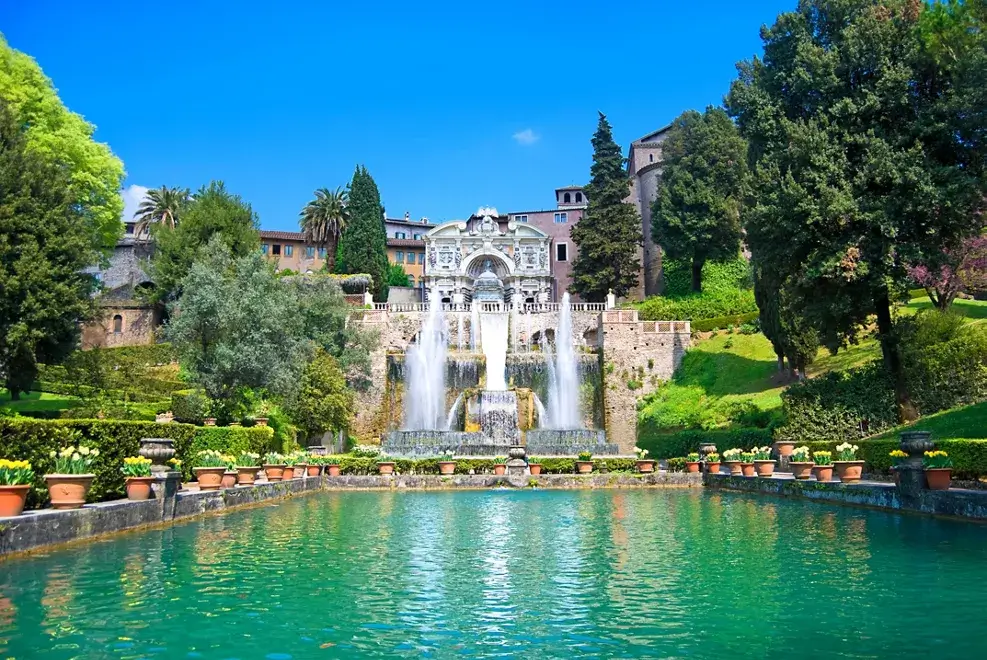
Behind the villa, on the steep hillside, is the Teatro delle Acque — the «Theatre of the Waters» — Della Porta’s most ingenious single creation. The teatro is a curved hemicycle of niches, each containing a statue of a classical river god, from which water cascades down a series of stepped basins to the central nymphaeum. The waterworks are driven entirely by gravity from a spring three hundred metres above the villa, and the entire system — channels, sluices, basins — has been working continuously since 1602. The theatre is the most theatrical single garden monument of late-Renaissance Italy, and the model for every baroque waterworks that followed, including those of the Villa d’Este. The visit to the theatre and the upper cascades is two hours.
The Italian garden: the original 1602 plan
The Italian garden in front of the villa — the parterre, the geometric box-hedge designs, the topiary cypresses — has survived in its original 1602 layout, almost uniquely among Roman villa gardens (which were almost universally altered in the 19th century). The walk through the garden takes one hour; the geometric design is best read from the upper terrace, where the entire pattern reveals itself as a single mathematical composition.
How we propose the day
The architectural day at Villa Aldobrandini is four hours. We propose it as the morning of a wine-and-architecture day, combined with the Frascati noble-villas wine day in the afternoon — the two together cover the architectural and oenological completeness of Frascati. For guests preferring a longer Lazio architectural programme, the morning at Villa Aldobrandini combines naturally with an afternoon at Tivoli’s Villa d’Este — the two Late-Renaissance waterworks of central Italy, read in a single intensive day. The day is also available within our Tour of the Roman Castles.
To curate a private architectural day at Villa Aldobrandini, contact Olga via Telegram.
From the Journal to your private day
Live this privately

Every day is composed around you — your pace, your interests, your time. Tell Olga what you would like to see.
Speak with Olga All private tours in Rome Build your day