



The Jewish Ghetto of Rome: A Private Walking Tour of History and Cuisine
Five small streets between the Tiber and the Largo di Torre Argentina hold one of the oldest continuously inhabited Jewish communities in Europe — and one of the most affecting culinary traditions in Rome. The Jewish Ghetto, established by papal bull in 1555 and fully emancipated only in 1870, is today both a working religious neighbourhood and an open-air museum of two thousand years of Roman-Jewish history. A privately guided walking tour through the Ghetto, properly arranged, is one of the quietly profound experiences available in central Rome.
The deep history: two thousand years of Roman Jews
The Jewish community of Rome is the oldest in continuous existence anywhere in Europe outside Israel — older than the medieval Jewish communities of Spain, France, Germany or England. Roman Jews trace their presence in the city to the second century BCE, well before the destruction of the Second Temple in 70 CE. The arrival of Jewish prisoners after that destruction is depicted in the Arch of Titus — the relief of the menorah carried in triumphal procession, which the Roman Jewish community refused, by custom, to walk under from antiquity to 1948. (When the State of Israel was declared, they walked under it for the first time.) The Ghetto period — 1555 to 1870 — was three centuries of confinement, regulation, and persecution; the Holocaust period of 1943-44 was a final, devastating chapter that took 1,259 Roman Jews to Auschwitz, of whom seventeen survived. The neighbourhood today is, deliberately and powerfully, a place of memory.
The walking route
A privately guided morning begins at the Portico of Octavia — the second-century BCE structure that became, during the Ghetto period, the site of an enforced Christian sermon every Saturday that Roman Jews were required to attend. From there into Via del Portico d’Ottavia, the spine of the old Ghetto, where the surviving medieval houses (with their distinctive small windows and three-floor maximum) sit alongside the great Synagogue of Rome — built in 1904 in a deliberate Babylonian-Assyrian style intended to assert a non-Christian, non-Roman identity. The visit to the Jewish Museum of Rome, housed in the synagogue, includes ritual silver from the Renaissance, manuscript Torah scrolls, and the very specific documentation of the October 16, 1943 deportation.
The route continues to the Fountain of the Turtles in Piazza Mattei — one of Rome’s most beautiful smaller fountains, mistakenly placed in Ghetto memory but in fact just outside the original walls — and to the inconspicuous brass stolpersteine (stumbling stones) embedded in the cobblestones, each commemorating an individual deportee at the precise address from which they were taken.
The cuisine: a separate, codified tradition
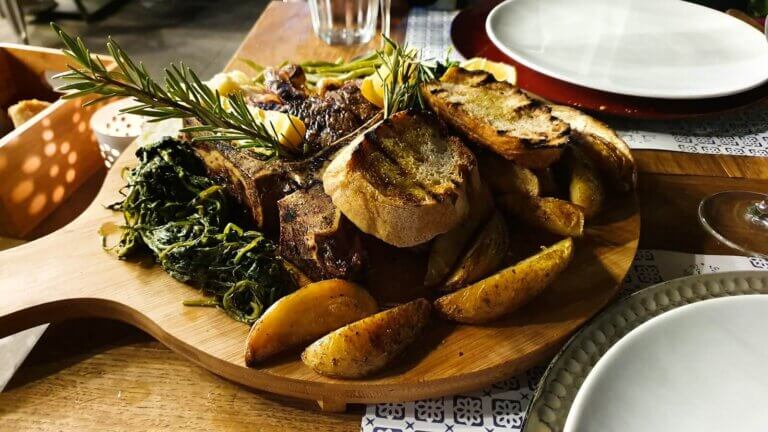
Roman-Jewish cooking — cucina ebraico-romanesca — is one of the most distinct regional cuisines in Italy, codified in the long centuries of confinement and built around the dietary restrictions of kashrut. Its canonical dishes are not analogues of Roman cooking but parallel inventions: carciofi alla giudia (the famous flattened deep-fried artichoke, twice fried, exterior the colour of mahogany, interior pale and meltingly tender); aliciotti con l’indivia (anchovies layered with curly endive); fritto vegetale (battered courgette flowers, broccoli, salt cod); and the cylindrical torta di ricotta e visciole — sour cherry and ricotta tart that is, for many Romans, the best dessert in the city.
A serious morning in the Ghetto concludes, ideally, with lunch at one of two long-established kosher trattorias on Via del Portico d’Ottavia — Nonna Betta or Ba’Ghetto — where the canonical menu is served in its traditional sequence. We always book in advance; the tables are tight and the kitchen takes its time.
What this morning is, and is not
It is a working religious neighbourhood. Photography is appreciated to be discreet — particularly on Saturdays, when the Sabbath is observed and the synagogue is closed to visitors. The Jewish Museum is closed Saturdays and Jewish holidays; Sundays are quiet but the cuisine is at its weekend best. The Holocaust history is present but not insistent; our guide treats it with the care it deserves and is happy to answer the questions guests ask. The Ghetto is also one of the safest neighbourhoods in central Rome at night, and many of our guests return for a quieter dinner two evenings later.
Pairing with the wider Rome
The Ghetto walking tour pairs naturally with our private Rome sightseeing tour the following day — the Capitoline, just above the Ghetto, makes the historical geography immediately clear. For families with serious cultural curiosity, we sometimes follow the Ghetto morning with a private mosaic and fresco masterclass in the afternoon — the workshop is two streets away. And for travellers also drawn to the spiritual landscape of Rome, our previous Sacred Rome curated journey includes the Ghetto as one of its final reflective stops.
To arrange a private Ghetto morning, write to Olga via Telegram.
From the Journal to your private day
Live this privately
Every day is composed around you — your pace, your interests, your time. Tell Olga what you would like to see.
Speak with Olga All private tours in Rome Build your day